North Node Cycle and Position
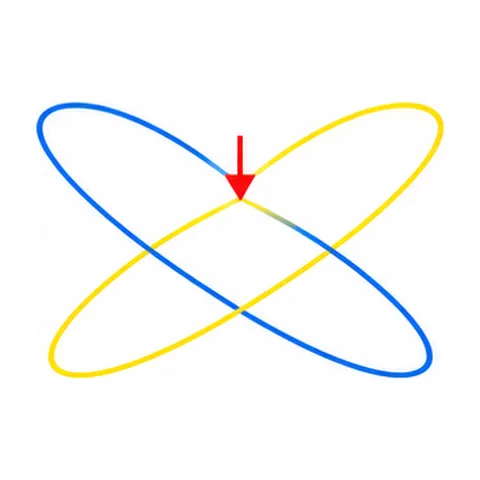
North Node is in
AquariusR
23°57′34″
−0.0960° a day · retrograde
Sidereal (Lahiri) Capricorn 29°43′
Next sign change
CapricornR
Sun, Mar 26, 4:37 PM GMT · in 485 d 4 h
Next station
The true node shifts direction every few weeks; stations are not listed for it.
In numbers
- 567.2 daysaverage stay in a sign
- 536.8 to 633.2 daysshortest to longest stay
- 74%of the time retrograde
Counted over 1950-2050.
North Node through the signs in 2026
Dates in London (GMT).
- PiscesThu, Jan 1 → Mon, Jul 27
- PiscesMon, Jul 27 → Mon, Jul 27
- PiscesMon, Jul 27 → Mon, Jul 27
- AquariusRMon, Jul 27 → Fri, Jan 1
The North Node’s current zodiac position marks where the Moon’s orbit crosses the ecliptic toward the north. It is an orbital point, not a planet, and its true position can shift direction briefly as it moves around the zodiac.
Where the Node Comes From
The North Node marks the point where the Moon’s orbit crosses the ecliptic while moving north. It is not a physical body. Because this page tracks the true node, it reflects a small wobble in that crossing. The South Node always sits directly opposite, forming an axis that astrologers use in chart interpretation.
A Slow, Uneven Circuit
The North Node travels backward around the zodiac in about 18.6 years. Its true motion sometimes turns forward for a few days. In calculations covering 1950 to 2050, it averages 567.2 days per sign and is retrograde 74 percent of the time. Those averages describe that full period; individual passages vary with the wobble.
Its Place in Astrology
Astrologers traditionally interpret the North Node as a symbolic point in a chart, with meanings shaped by the school or method they follow. The node is an orbital intersection rather than one of the seven classical planets, so it has no planetary weekday or place in the traditional planetary hours. The zodiac setting is tropical unless the Lahiri sidereal option is selected.
Questions
What does the North Node mark?
The North Node, also called the true node, marks where the Moon’s orbit crosses the ecliptic while moving north. It is an orbital intersection, not a planet or physical object. The South Node is always exactly opposite it.
Why can the true node move forward?
The node usually travels backward around the zodiac, but the true node wobbles as the Moon’s orbital crossing shifts. That wobble can make it move forward for a few days before its usual backward motion resumes.
How long is a North Node sign passage?
Across calculations from 1950 to 2050, the North Node averages 567.2 days in a sign. This is a mean, not a fixed duration for every passage. Its true motion wobbles, and it moves retrograde 74 percent of the time over that span.
More from the sky
Planetary hours
Every hour of the day and night, with its ruler.
Moon sign today
Sign, degree and the next change.
Void-of-course Moon
Is the Moon void now, and when next.
Current transits
Aspects in orb with exact times.
Planetary days
Today’s ruler, from sunrise.
How planetary hours work
The method in plain steps.

The sky this week
Ingresses, voids and exact aspects.
Methodology
How every number is computed.